
Vitamin D Supplement Manufacturer – D3, D3+K2 and Combined Formulas
Noviatic is a European contract manufacturer of finished food supplements, based in Vilnius and Kaunas, Lithuania. We formulate and manufacture Vitamin D supplements – D3 drops, D3+K2 combinations, capsules, softgels, tablets and sublingual sprays – for supplement brands, pharmacy chains and distributors across 40+ countries, inside our own GMP-certified facility.
Not all Vitamin D is the same. The form matters.
Vitamin D exists in two supplemental forms – D2 (ergocalciferol) and D3 (cholecalciferol) – and the distinction is worth understanding before briefing a formula.
D3 is the form the human body produces in response to sunlight. It is also the form most European supplement brands work with, because research consistently shows D3 raises and maintains serum 25(OH)D levels more effectively than D2 at equivalent doses. It’s the default form for most markets and most consumer positioning.
D2 is plant-derived – which makes it the form of choice for vegan-positioned products, since most D3 is derived from lanolin (sheep’s wool).
The form choice is made at the brief stage. It affects sourcing, label claims and market positioning before production begins.

The combination that's become a category standard – and why it exists
Vitamin D3 promotes calcium absorption in the gut. That’s well established and well documented. What’s less often explained is what happens after the calcium is absorbed – specifically, where it goes.
Vitamin K2 (menaquinone, most commonly MK-7) activates proteins that direct calcium to bones and teeth, and away from soft tissue such as arterial walls. D3 and K2 work on the same calcium pathway at different points – which is why the combination became a formulation standard for bone health and cardiovascular wellness positioning, not just a marketing pairing.
For brands building in the bone health, healthy ageing or cardiovascular wellness space, D3+K2 is often the expected formula rather than the differentiated one. The differentiation comes from dose, format and the K2 form used – MK-7 is the most bioavailable and the most recognised by European consumers.
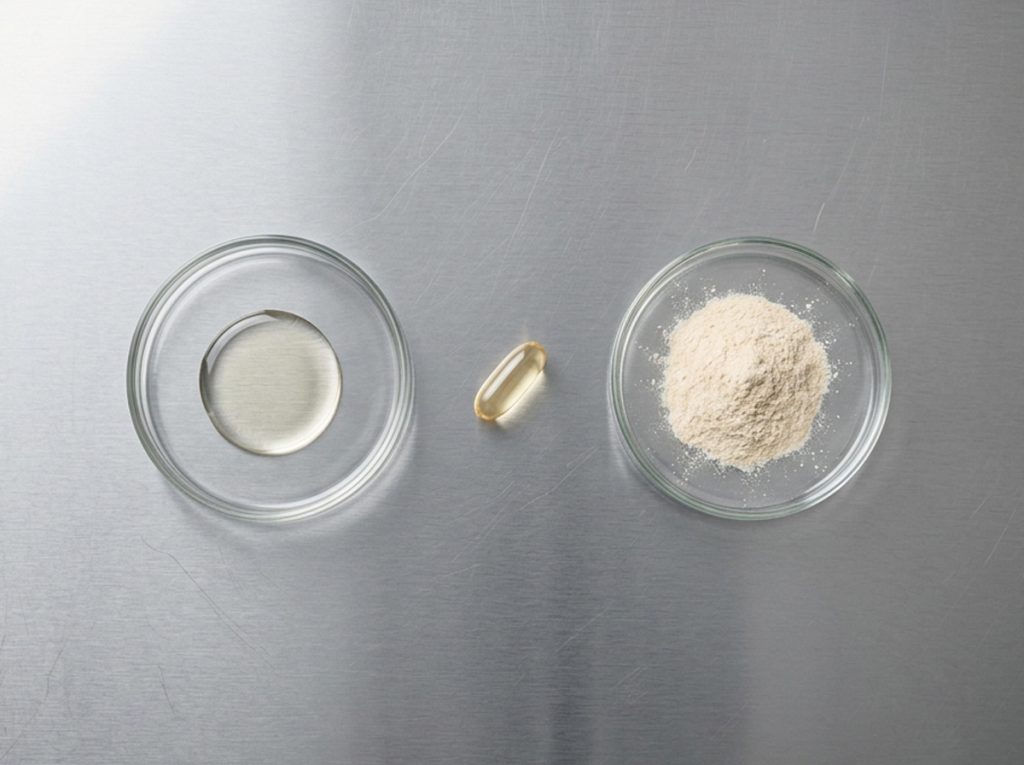
Vitamin D is fat-soluble. The format has to reflect that.
This is the formulation decision most brands don’t ask about upfront – and the one that most affects how much of the label dose the consumer actually absorbs.
Vitamin D3 is fat-soluble. It needs a lipid environment to be absorbed in the small intestine. A standard compressed tablet without an oil carrier delivers the active – but the absorption depends entirely on what fat the consumer happens to have consumed with it. A softgel, an oil-based drop or a liposomal formula builds that carrier into the product, making absorption far less dependent on what the consumer ate for breakfast.
Format | Carrier | Best for |
Oil-based drops | MCT, sunflower or olive oil | Children’s dosing, flexible adult dosing, daily maintenance |
Softgels | Oil-filled shell | Standard adult daily supplement, high-absorption positioning |
Sublingual spray | Water or oil base | Fast-uptake positioning, convenient daily format |
Tablets | Dry compression, no oil carrier | Cost-efficient at scale; absorption is diet-dependent |
Capsules (hard) | Powder fill, no oil carrier | Standard adult format; oil-filled variants available |
Liposomal (Miosol™) | Phospholipid encapsulation | Maximum absorption claim, premium positioning |
The format decision is made at the brief stage and determines what the product can claim, how it’s positioned and which consumer it’s built for.

The dose determines the channel, the claim and the consumer
Vitamin D has authorized EU health claims for the normal function of the immune system, maintenance of normal bones and teeth, and normal muscle function – but the dose has to be appropriate to the claim and the target consumer. Different dose tiers suit different retail channels and brand positions.
Dose | Typical positioning | Suited to |
400–600 IU | Children’s maintenance | Paediatric drops, syrups, chewables |
1,000 IU | Standard adult daily supplement | Pharmacy staple, general wellness |
2,000 IU | Moderate high-strength | DTC brands, health-conscious adult consumers |
4,000 IU | High-strength | Pharmacy, deficiency-support positioning |
5,000 IU+ | Therapeutic/clinical | Specialist brands, clinical channels |
The right dose for your product depends on your target market, retail channel and the health claim you want to make.
Vitamin D3 degrades. Packaging is part of the formula.
D3 is sensitive to light and oxidation – both accelerate degradation and reduce potency over shelf life. This is not a formulation afterthought. It’s a packaging decision that has to be made alongside the formula.
Amber glass or opaque packaging limits light exposure. Nitrogen flushing at filling limits oxidative degradation in the headspace. For oil-based drops and softgels, the oil carrier itself can oxidise – which is why we apply the same oxidation testing to Vitamin D oil-based formats as to our omega-3 products. Potency is confirmed at release and validated through stability testing across the full shelf-life window.
A Vitamin D product that meets its label claim at manufacture but falls below it at month 18 is a regulatory and brand problem. We build stability into the formulation and confirm it through testing, not labelling assumptions.

Your formula. Our formula. Or something new?
Have a Vitamin D formula already?
Contract manufacturing runs your specification – D3 dose, K2 form, carrier, format – on our equipment, through our QC, out the door under your label.
[See contract manufacturing →]
Want a faster route to market?
Our private label library includes tested Vitamin D formulas across drops, capsules, tablets and D3+K2 combinations. Most can be adjusted on dose, format or K2 form.
Starting from a brief?
Our R&D team develops custom Vitamin D formulas from format selection and carrier choice through stability testing, pilot batch and scale-up.

Tell us what you're building. We'll get back to you quickly.
Share your format, indicative volume and target markets and we will come back to you within a few business days to confirm receipt and let you know what we need to prepare a full response. Pricing, capability details and a fit assessment follow as soon as we have reviewed your brief.
What brands ask us about vitamin D manufacturing?
What is the difference between Vitamin D2 and D3?
D3 (cholecalciferol) is the form the body produces from sunlight and the form most supplement brands use. It raises serum Vitamin D levels more effectively than D2 at equivalent doses. D2 (ergocalciferol) is plant-derived and used in vegan-positioned products.
Why is Vitamin D3 usually combined with K2?
Vitamin D3 promotes calcium absorption. Vitamin K2 (typically MK-7) activates proteins that direct that calcium to bones rather than soft tissue. The combination addresses the full calcium pathway, which is why D3+K2 has become the standard formula for bone health and cardiovascular wellness positioning in European supplement retail.
Does the format affect how much Vitamin D is absorbed?
Yes, meaningfully. D3 is fat-soluble and needs a lipid carrier to be absorbed efficiently. Softgels, oil-based drops and liposomal formats build that carrier into the product. A standard compressed tablet without an oil carrier depends on dietary fat at the time of consumption. For products where absorption is the core claim, format choice is as important as dose.
What dose of Vitamin D should my product contain?
It depends on your target consumer, retail channel and the health claims you want to make. Children’s maintenance doses run from 400–600 IU. Standard adult supplements typically use 1,000–2,000 IU. High-strength and deficiency-support positioning runs from 2,000–4,000 IU. Upper limit guidance varies by EU member state – confirmed per market during the brief.
What packaging is recommended for Vitamin D drops?
Amber glass or opaque bottles to limit light exposure, with oxidation controls at filling. D3 is light- and oxidation-sensitive – packaging is part of the stability strategy, not a separate decision.
Do you offer private label Vitamin D formulas?
Yes. We hold tested, ready-to-sell formulas across D3 drops, D3+K2 tablets and capsule formats. Most can be adjusted on dose, K2 form or format before the production run.
What testing does each Vitamin D batch go through?
Identity, potency (confirmed D3 and K2 content where applicable), heavy metals and microbial count. Oil-based formats are additionally tested for oxidation. Potency is confirmed at release and through stability testing across the full shelf-life window. Not every test applies to every product; what’s required is agreed with you upfront and confirmed in the specification.